Puerto Rican Secularism: The Good, the Bad, and the Ugly

After digging the data from Pew for my previous post on atheism and non-religion in Puerto Rico, I decided to dig a bit deeper. I found more interesting pieces of information about the state of secularism in Puerto Rico. By secularism I mean not just the religious identification of people, but also their attitudes about religion and politics, as well as morality and public policy. The information can be divided in 3 types: good, bad, and ugly.

The Good

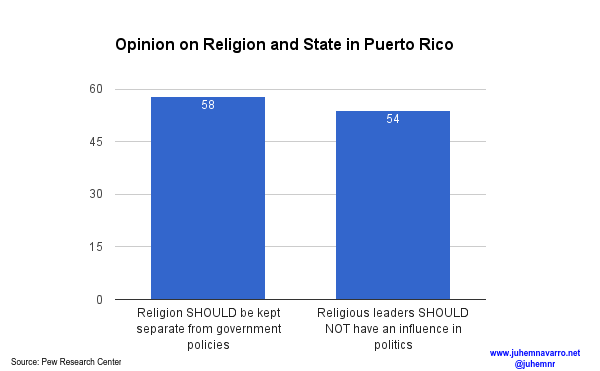
A majority of Puerto Ricans think the government should stay out of religion and that religious leaders should stay away from politics. Nearly 6-in-10 (58 percent) think that “religion should be kept separate from government policies.” Of course, this is something that elected officials have not been very good at, with the main example being the issue of susbtance abuse treatment I alluded to in my previous post.
rel_govt

Another hopeful sign is that a majority think that “religious leaders should not have an influence in politics.” This means that most people probably don’t like the many religious ceremonies often endorse or attended by elected officials.

In an unrelated note, though important for education policy. Nearly two-thirds (65 percent) of Puerto Ricans believe humans and other animals have evolved over time. This is encouraging, given the prevalence of religious schools, especially those run by Pentecostal ministries.

The Bad

Those are the good news, now the bad. In terms of views on social policy, even if most Puerto Ricans are religion/government separationists, their views on morality are very conservative. Take the example of same-sex marriage. While it is now legal, thanks to the Supreme Court recent decision, at the time of polling last year only one-third (33 percent) favored allowing people of the same sex to marry legally.

ssm_rel

The patterns of support among religious groups are predictable. Similar to what scholars find among religious groups in the United States, as this post by Public Religion Research Institute shows, Puerto Rican Protestants are the least supportive. Only 1-in-5 (20 percent) Protestants favor same-sex marriage. The percentage of Catholics in favor of same-sex marriage is nearly twice that of Protestants (39 percent) but still low. Even the religious nones in Puerto Rico are not fully in favor of same-sex marriage. Just under half (49 percent) of Puerto Rican nones favor same-sex marriage, a percentage much lower than the more than three-quarters of nones favoring same-sex marriage in the United States.

The Ugly

Support for same-sex marriage is low and so are the views on the morality of same-sex relationships. More than 6-in-10 (62 percent) say that same-sex relationships are immoral. Still opposition to same-sex marriage not as high as opposition to abortion. About three-quarters (77 percent) of Puerto Ricans consider abortion should be illegal and that abortion is immoral (74 percent).

Puerto Rican secularism needs to evolve. There are some positive signs regarding attitudes toward religion and government. However, religious belief is likely behind attitudes on social issues such as same-sex marriage and abortion. Fortunately, religion is not a large factor affecting belief in evolution. Another silver lining on social attitudes is that the vast majority do not think contraception use is immoral. The nones should take the positive signs and use them to change Puerto Rican politics and society harnessing those positive attitudes on religion/government separation.

Tropical & Godless: American Atheists in San Juan

American Atheists is having a regional meeting in Puerto Rico this weekend. When we think of Puerto Rico and religion, there’s an assumption that all of the people in the island are Catholic. For example, in the 2008 exit polling of the Democratic Party Presidential Primaries the media companies in charge of the Exit Poll Pool decided to leave religion out of the Puerto Rico questionnaire. This issue was addressed by my former colleague Mark Silk who promoted a comment I had made in a previous post on that primary. Unfortunately, there’s not a lot of research polling on religion in Puerto Rico. Luckily, the Pew Research Center included Puerto Rico in their large study of religion in Latin America last year.

According to the Pew poll, 8 percent of Puerto Ricans are what they call “religiously unaffiliated.” They’re basically people with no religious identification. The majority of Puerto Ricans still call themselves Catholic, but a large segment of the population, one-third (33 percent) to be precise, are Protestant.

What about atheists? The topline results of the poll (page 33 here) show that only 1 percent of Puerto Ricans identify as atheist. We must remember, though, that religious identification and religious belief are two different things. It may well be the case that some people in Puerto Rico do not believe in a god, but do not identify their religion as “atheist.” I know, because I am one of those persons who refuses to identify atheism with religion.

Fortunately, Chapter 3 of the report includes a discussion on religious beliefs. It does not seem to be the case that there are more nonbelievers than self-professed atheists. Ninety-nine percent of Puerto Ricans claim to believe in God. This makes the 1 percent figure of self-identified atheists and non-believers consistent with one another.

PR_rel2015But we must not despair. Eight percent of the adult population are religious nones. Although 91 percent of them claim to believe in God, we need to understand these numbers in their context. Many of these nones may be going through a process of rethinking their beliefs. Only 3 percent of Puerto Ricans claimed that they grew up with no religious affiliation and that number has nearly tripled.

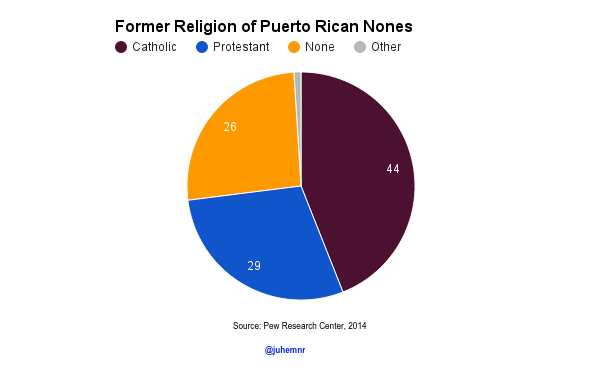
PR_nones2015The Nones in Puerto Rico are mostly former Catholics and Protestants. The growth of the Nones in Puerto Rico is not just the case of non-practicing (or nominal) Catholics just admitting they don’t really have any attachment to the old religion and that’s encouraging news. Nearly 30 percent of Nones are former Protestnts, so even people from the group that has the highest rates of church-going and belief are leaving.

Considering how pervasive religion is in Puerto Rico, this is a big deal. This is a place where substance abuse treatment is openly religious, and addiction is classified as a “spiritual ailment.” This is a place where education, little by little, has become privatized and taken over by “nonprofit” ministries. A place where the police organize traffic stops to preach. I did not identify as an atheist until I moved to New England after graduating from college. I identified myself a “deist,” a believer in a higher power. The very secular culture of New England made it safe for me to be openly atheist. I did not feel that comfortable being an atheist in Puerto Rico.

Maybe the high visibility of the convention, combined with the introduction of the Church of the Flying Spaghetti Monster and groups like Humanistas Seculares de Puerto Rico and Ateistas de Puerto Rico openly challenging the privilege religious organizations have in everyday government functions will change the dynamics. And the future seems bright. The Pew poll also shows that the nones in Puerto Rico are, on average, 7 years younger than Protestants and 10 years younger than Catholics. I wish I had institutions I could rely on two decades ago. Hopefully the new generations of non-religious Puerto Ricans will experience the freedom I couldn’t feel. 

Featured image: Humanistas Seculares de Puerto Rico

Throwback Thursday: Secularism & Stability

Note: Every Thursday I bring “back to life” a post from the old LatiNone blog. Today’s post was originally published on May 14, 2011-JNR

From Gallup:

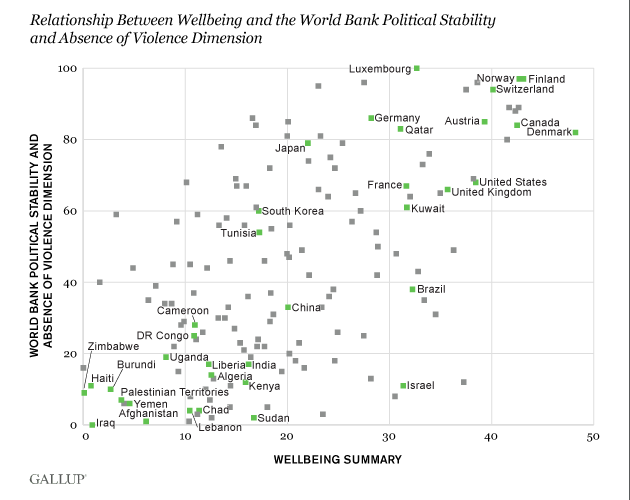
a new Gallup analysis finds countries with the highest wellbeing tend to be the most peaceful countries in the world and those with the lowest wellbeing are the least likely to be peaceful. Gallup’s life evaluation measure, which gauges wellbeing, correlates strongly with the Failed States Index and the World Bank’s Political Stability and Absence of Violence dimension, suggesting a clear linear relationship between peace and high wellbeing.

Not coincidentally, these countries are also highly secular. And the link between secularism, peace and wellbeing is one that is found in social science. In fact, Pitzer College professor and founder of the new Secularism Studies major, Phil Zuckerman, did a video lecture on this for ISSSC a while ago.

While there are certainly other factors involve in wellbeing and peace, secularism (and secularity) should be atop of social science explanations.

The Nones Look Like America

Source: Pew Research Center

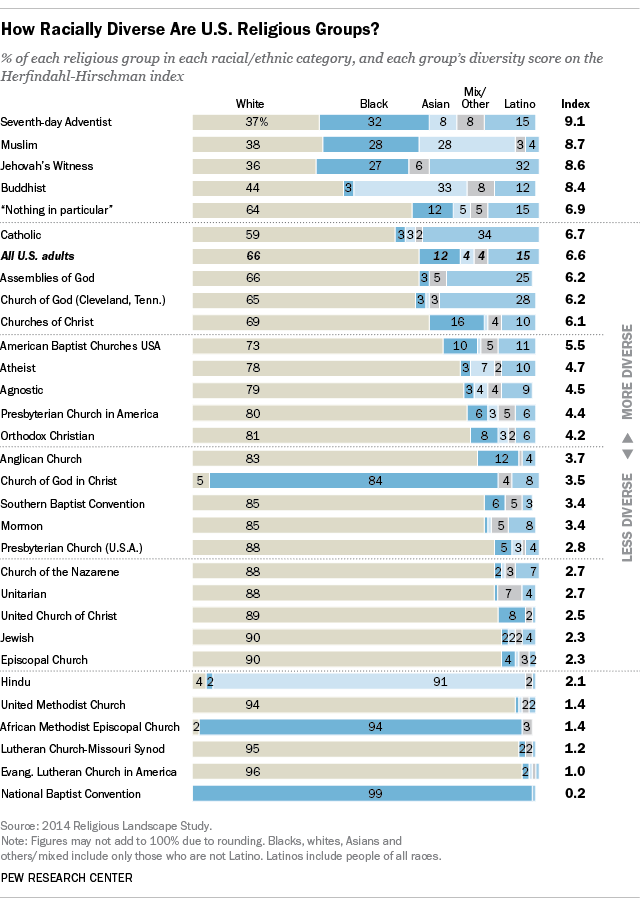
The Pew Research Center recently released some numbers about the diversity of religious groups in the United States. To measure diversity, they gauge how evenly divided each religious group among 5 racial and ethnic groups in the United States: whites, blacks, Latinos, Asians, and “other”. If each of the 5 racial groups account for one-fifth (20 percent) of the larger religious group the score is a perfect 10.

The most diverse groups are Seventh-Day Adventists, Muslims, Jehova’s Witnesses, Buddhists, and the Nones in that order. However, while the first four groups are the most diverse in the sense that most of their membership comes from racial and ethnic minorities, the Nones are the group that most closely reflects the demographic composition of the country.

The score of the Nones is 6.9, 1.5 points lower than the 4th-ranked Buddhists but their racial distribution nearly matches that of the nation as a whole. Just a few years back, this was not the case, and there are still ways to go. Atheists and agnostics are still overwhelmingly white. Moreover, while the Pew post discusses racial diversity, this is not the only source of diversity. The group is still mostly male, though some progress has been made. It would have been nice to see how gender diversity could affect the rankings.

The good news about this chart is that the Nones are growing parallel to the general population. That was the subject of my first talk at the CFI leadership conference at the end of July and it is great to see it in an infographic. The group is drawing from the country’s racial diversity. In other words, the Nones look like America.

The Donald’s Latino Support is not “Suprising”

A recent piece at The Daily Dot tries to explain Donald Trump’s “surprising” 13 percent support among Latinos. The “explanations” are that Latinos are a diverse bunch and that because Trumps scapegoats Mexicans, many Latinos still “mysteriously” favor him. Of course, 13 percent is small. In a sample of 250 voters (the number of Latinos in the survey cited), this is about 35 people.

I don’t think that fining 13 percent of Latino voters supporting Trump is surprising at all. Trump has a high level of name recognition among all Americans. Many Latinos in the US and people in Latin America recognize Trump for his Miss Universe pageant. I still recall during my teenage years when I was living in Puerto Rico and Miss Universe was a big deal and the local press would highlight whatever the Donald said about our representative. His statement was always flattering the beauty of the contestant since the Donald only cares about the looks of women. The pageant was not just popular in Puerto Rico, but through the region.

Rather than the 13 percent who would vote for Trump, I am surprised by how much attention his statements about Mexican immigrants have received. A recent Univision poll shows that 90 percent of Latinos know about the statements, 71 percent of Latinos have an unfavorable opinion of Trump, and that 79 percent of Latinos find the comments offensive. This latter number includes 77 percent of Latinos who are NOT of Mexican descent. Many Latinos are savvy enough to realize that ignorant bigots use “Mexican” to refer to any type of brown person with an accent where the “Rs” are rather strong.

The Donald’s campaign is highlighting an ugly side of the Republican coalition. At a time when the GOP thinks it is necessary to improve relations with Latino communities, Trump’s surge to the lead at the polls shows the disconnect between some of the party elites’ goals and the rank-and-file feelings. Most Latinos do not identify as Republican and most people in general do not pay attention to the Presidential Elections until they are well underway. But Trump’s statements have made Latinos pay attention to what would be an obscure affair to most of them. And that’s the real surprise of Trump’s run.

Featured image: Donald Trump tours the US-Mexico border (Source: NBC News)

Press 1 for English, 2 for Spanish

A Salvadorean-American family went for a celebratory meal to a Los Angeles-area IHOP. There, they did what people usually do, have a conversation in the language they are most comfortable with while waiting to be seated. That language happened to be Spanish and an older white woman decided to intervene and stand up for America…or something.

Old white woman just gave a textbook example of how white supremacy works. You are in place named “Los Angeles” and yet Spanish is prohibited. You ask a random person to go “back to Spain” because “Spanish” comes from there, but you don’t even realize that taking that statement to its natural conclusion means you live in England. Her ignorance is not a liability, she has the ego to think she can lecture another woman about what language she should speak.

I saw the mother and son fight back, in English. That fact made me happy, but the video still made me sad and angry for many reasons. One, that Latinos still have to go through incidents like this that ruin a birthday. That this happened in Los Angeles of all places also made me angry. If you can’t be left alone speaking Spanish in Los Angeles, where can you do it?

I often wonder why people do stuff like this. Is it because they’re naturally nosy and are mad they can’t eavesdrop on other people’s conversations? Is it because they feel “unsafe” about being invaded by “barbarian hordes” but safe enough to warrant a confrontation? I guess she didn’t expect a confrontation. They never do. They expect you to crawl back to your place, maybe even apologize and leave. But they are taken aback when you push back. That is when they know we’re here to stay and that always they will have to press 1 for English and 2 for Spanish.

https://youtu.be/aRW98PWwYYU

Air Conditioning is the Key to Rise of the Nones

A new Baylor University study of counties in the United States finds that those with “with more beautiful weather and scenery have lower rates of membership and affiliation with religious organizations.” It makes sense looking at the top metro areas in terms of their percentage of religious nones. Portland, Ore. (42 percent), Seattle, San Francisco (33 percent each), and Denver (32 percent) rank as the least religious metro areas according to the American Values Atlas (see chart below). They are also beautiful places, and great for outdoor activities.

Top-Three-Religions-by-City
Click to see full size

The metro areas with the lowest percentages of nones tend to be in the South. Nashville, with 15 percent finally caught up to the rest of the country (in 2008). After the capital of country music, Charlotte has the lowest percentage with 17 percent. Several Southern cities are also tied in the next tier. In Atlanta, Dallas, Houston, and Orlando the none population is 18 percent, as is in Pittsburgh , which has the lowest percentage of nones in a non-Southern city.Yup, hot weather and religion go together.

The lesson of the Baylor study is that the secular movement needs to invest in nice buildings with air conditioning. Maybe that’s why mega churches in the region are legion. Air conditioning can create heaven on Earth, at least in places where the weather approaches hellish temperatures.

Buffalo buffalo Buffalo buffalo buffalo buffalo Buffalo buffalo

I was in Buffalo over the weekend. Not really in Buffalo exactly but in Amherst, NY at the Center for Inquiry’s global domination headquarters. I was a featured speaker at CFI’s annual leadership conference. This year’s theme “Moving Freethought Forward” clearly aligned with my current research interests in race and politics among secular Americans.

I arrived in Buffalo on Friday morning after being stranded for a while on Thursday night (airport celebrity sightings: Curt Schilling and Sen. Elizabeth Warren). After a brief check-in at the hotel and working a little on the first of my two presentations, I went to the CFI headquarters and was able to catch some of the morning sessions. The speakers in those sessions were some of the student participants discussing how their own college (or high school groups) organize and conduct events. The CFI staff also presented about some of their projects.

Watching those presentations gave me an idea of who most of my audience was (the other audience members were leaders of CFI branches, who at the time attended a different event). My first presentation was on the increasing diversity of secular Americans. While initially I focused on race, building on my presentation at the American Humanist Association conference in May, I shifted gears a bit and also discussed sex and gender identity. The movement, or at least the greater secular community, is not just a collection of old white males. Using data from my previous employers, the Institute for the Study of Secularism in Society and Culture (ISSSC) and Public Religion Research Institute (PRRI), I showed that the percentage of people of color and women have increased over time among the “nones.” I also included data on LGBT Americans that shows high levels of secularism among this population.

Sharing the stage with James Baldwin and Nemesio Canales

After the statistical part of the presentation I discussed why these groups are increasingly secular. While education is part of the explanation, I moved away from the usual STEM explanation: that as people learn about science they become more secular. Instead I argued that questioning the power structures in society can be a path to secularism. The picture on the left shows the slide where I placed two secular thinkers of color: James Baldwin and Nemesio Canales. Their secularism wasn’t the kind that refutes religion with science but the one that questions divine authority in light of very inefficient results.

I finished the presentation with a segway to my next presentation. In a slide showing different political leaders of different religions I made the argument that the politics of religious groups in America vary by race: white and black Protestants vote differently, as do white and Latino Catholics. But this is not the case with the Nones.

Trying to explain how to make up for a 40-year organizational deficit.

My second presentation compared a bit the secular left and religious right. They are mirror images of each other, with the exception that the latter is a major force in American conservatism, and the former a bunch of people who tend to agree on political and social issues. My goal was to show that regardless of nomenclature (nones, atheists, agnostics), secular Americans largely agree on the issues that are important today. Moreover, they also have similar levels of political party affiliation, and have been abandoning the GOP in the last quarter-century.

I liked how my presentations were received. Several students and leaders talked to me about what they liked and to continue a bit the conversation. Overall, it was a great conference. The diverse faces in the crowd: young men and women reflective of America’s diverse population give me hope about the future of the movement. Of course, the conference was not possible without the hard work of the CFI crew. I was finally able to meet Debbie Goddard in person and chat again with Paul Fidalgo. I also met Sarah Kaiser, Stef McGraw, and Cody Hashman, who made my life easier handling logistics and tech. And I had the opportunity to meet some amazing fellow presenters: Columbia’s Melanie Brewster, a rising star in the secular scholarly community; Desiree Schell is the person who can put in practice whatever theory of politics I come up with; Keith Lowell Jensen made my face hurt with his jokes, especially those about Max, his 5-year old tweeting daughter; and is always good to see James Croft, one of the most engaging speakers around and whose presentation was, luckily, after mine. I also want to thank Matt Enloe for tweeting a storm, the pictures in this post come from his account.

Born Again (Pun Intended)

It is amazing how fast time flies. Three years ago, as I settled into a new full-time job in a new city while trying to work on a dissertation, I decided to pause this blog. It was a tough decision. The LatiNone had become a place were I debated issues important to Latinos, to secular Americans, and to both communities at the same time. While it started as a place where I linked to articles with some snarky comment, eventually became my public voice. At the time of its indefinite suspension the blog was gaining readership thanks to my writing in other corners of the atheist blogosphere. Writing this blog led me to meet some incredible people, who to this day I still count as friends and important allies.

Now, with the prefix “Dr.” (or the suffix “Ph.D.”) secured before (or after) my name I have again the temporal currency to engage in semi-often commentary. In the years between the last post in 2012 and the first post in 2015 many things have changed in the communities I count myself member of. Latinos have shown some real political muscle.

In 2012, Latinos moved further away from a GOP that just a decade ago seemed on the verge of being actually competing for our votes. The current presidential crop led (but not really) by Donald Trump has continued the party’s quest to become a truly old-school party: one with no women or people of color, a real throwback to the 19th Century.

As for my other community, the nones, our size in the electorate, our voting margins for Obama and Democratic candidates are similar to those of Latinos. But we (the nones) don’t get the same attention. We have to change that. The religious right has a 40-year head start, we must catch up fast.

Other themes of the blog will include book and movie reviews and some ephemera. Politics, as always, will not be limited to U.S. national politics, and I’ll chip in with some unrequested opinion about other countries, whether it is religion or race.

And with this post, The LatiNone is officially Born Again®