If you’re in Houston this weekend, consider stopping by the Secular Social Justice Conference. A great group of secular activists and/or scholars of color will be discussing how to advance social justice in the growing secular community.
I look forward to reconnect with leaders like Sikivu Hutchinson, Anthony Pinn, the AHA’s Maggie Ardiente, and CFI’s Debbie Goddard. I also hope to meet others whom I’ve followed for a while like Sincere Kirabo and Alix Jules. Hopefully, Greta Christina also makes good on her promise and attends!
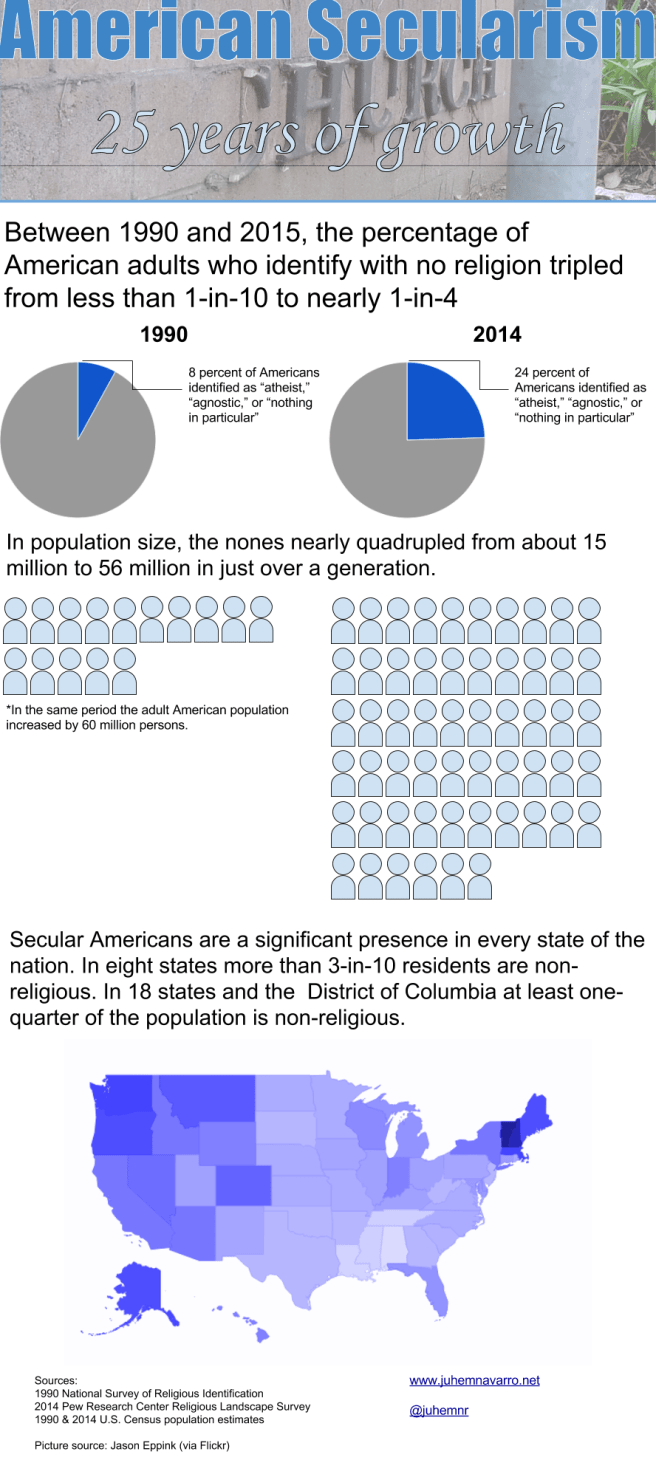
Today is December 12, the day of the Virgin of Guadalupe in Mexico. Which is a good day to remind people how Latinos’ religious composition has changed in recent years, and how large the secular cohort has become. We are now 20 percent of the Latino adult population, or 7.5 million. So, my secular Latino friends, look at this quick infographic and remember: you’re not alone.
This year is the 25th anniversary of the 1990 National Survey of Religious Identification. With a sample of over 100,000 interviews, it is the largest study of religious affiliation in the United States. Back then only 8 percent of Americans identified as “nones” or non-religious. Yet, when the successors of the NSRI, especially the 2008 American Religious Identification Survey, found that 1-in-6 Americans (15 percent) were non-religious, the press started noticing.
Today, the Pew Research Center and Public Religion Research Institute find that nearly one-quarter of the population is secular. The infographic below shows how this growth has happened percentage-wise and in terms of real population numbers.
The New Yorker recently published a piece profiling the deconversion of Megan Phelps-Roper. If the name rings a bell, it’s because she’s the grand-daughter of Fred Phelps, the late leader (and founder) of the infamous Westboro Baptist Church (WBC).
Phelps-Roper deconversion followed an interesting path. With access to the web, she joined Twitter and became the digital voice of the WBC. One of the features of Twitter is its ability of not only broadcasting a message, but also getting instant feedback. The WBC loves spreading their message, and this platform was well-suited for their usual trolling.
However, in Twitter Ms. Phelps-Roper also found a legion of detractors. Some of them later became friendly foes who engaged her as she spread the WBC’s message and planted the seeds of suspicion in her regarding the “truth” she had been taught. Ms. Phelps-Roper didn’t get interested in the theory of evolution, the Big Bang, or any other major scientific breakthrough that clashes with religious teachings. Her deconversion was a slow process emerging from a distrust of authority, a subject I recently-ish spoke about.
During one of my talks at the 2015 Center for Inquiry’s Leadership Conference I discussed the importance of non-scientific secularism. What I mean by this is that many people are becoming secular/non-religious not because they just got interested in biology or physics. Instead, people leave religion because they begin question its authority, and the authority of its leaders.
This is the case with Ms. Phelps-Roper. Her Twitter followers plated the seeds of distrust, but it was her analysis of how inconsistent and random the people in power at the WBC were with their new prophecies what led her to disbelieve what she had been taught.
It is also worth noting that one of the events that led to her leaving the WBC was the demotion of her mother as a major leader in the Church. Gender dynamics, where males took over absolute control of Church affairs, further fueled her questioning.
You should read the whole piece in the New Yorker. It gives great insights into the minds of young people leaving religion today. While Ms. Phelps-Roper case is an extreme one (in terms of the religious congregation she left), it is also an excellent example of how you don’t need science to distrust religion: its authority is dubious enough that people with critical thinking skills can see through the facade.
The most recent Pew poll released last week shows that the nones (secular Americans, aka: the “unaffiliated”) are becoming more secular, at least according to their own headline. In my humble opinion, the nones have just become more honest in their answers about their religious practices.
The recent report based on the belief and behavior questions in Religious Landscape Survey highlights two main findings. The first, that the nones are increasingly secular, the second that American soceity as a whole is also becoming more secular. As the figure below shows, the nones have become more likely to say religion is not important, more likely to admit they rarely pray or go to church. But the most amazing finding is that the percent who say they don’t believe in God increased by 50 percent, from 22 percent in 2007 to one-third (33 percent) in 2014.
Source: Pew Research Center
These numbers are the best evidence that being nonreligious is normalizing in American society. The trend is stronger among young people, who are more likely to know other nonreligious people. This may be because their friends in school or the neighborhood are not religious or because they are more technologically-minded and know other nonreligious thanks to the internet.
The other major finding of the report is that these measures of religious belief and behavior are declining among the population at large. However, the report is clear that there has been no major changes among religious Americans. This means that all of the change comes from the nones. This is very important because it means the nones are a group so large that they can now affect national trends by themselves. Hopefully we have not reached “peak secular” yet and more good news like these will continue to appear in future studies.
After digging the data from Pew for my previous post on atheism and non-religion in Puerto Rico, I decided to dig a bit deeper. I found more interesting pieces of information about the state of secularism in Puerto Rico. By secularism I mean not just the religious identification of people, but also their attitudes about religion and politics, as well as morality and public policy. The information can be divided in 3 types: good, bad, and ugly.
The Good
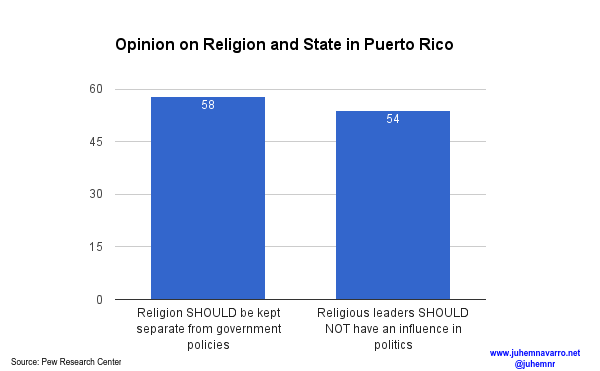
A majority of Puerto Ricans think the government should stay out of religion and that religious leaders should stay away from politics. Nearly 6-in-10 (58 percent) think that “religion should be kept separate from government policies.” Of course, this is something that elected officials have not been very good at, with the main example being the issue of susbtance abuse treatment I alluded to in my previous post.
Another hopeful sign is that a majority think that “religious leaders should not have an influence in politics.” This means that most people probably don’t like the many religious ceremonies often endorse or attended by elected officials.
In an unrelated note, though important for education policy. Nearly two-thirds (65 percent) of Puerto Ricans believe humans and other animals have evolved over time. This is encouraging, given the prevalence of religious schools, especially those run by Pentecostal ministries.
The Bad
Those are the good news, now the bad. In terms of views on social policy, even if most Puerto Ricans are religion/government separationists, their views on morality are very conservative. Take the example of same-sex marriage. While it is now legal, thanks to the Supreme Court recent decision, at the time of polling last year only one-third (33 percent) favored allowing people of the same sex to marry legally.
The patterns of support among religious groups are predictable. Similar to what scholars find among religious groups in the United States, as this post by Public Religion Research Institute shows, Puerto Rican Protestants are the least supportive. Only 1-in-5 (20 percent) Protestants favor same-sex marriage. The percentage of Catholics in favor of same-sex marriage is nearly twice that of Protestants (39 percent) but still low. Even the religious nones in Puerto Rico are not fully in favor of same-sex marriage. Just under half (49 percent) of Puerto Rican nones favor same-sex marriage, a percentage much lower than the more than three-quarters of nones favoring same-sex marriage in the United States.
The Ugly
Support for same-sex marriage is low and so are the views on the morality of same-sex relationships. More than 6-in-10 (62 percent) say that same-sex relationships are immoral. Still opposition to same-sex marriage not as high as opposition to abortion. About three-quarters (77 percent) of Puerto Ricans consider abortion should be illegal and that abortion is immoral (74 percent).
Puerto Rican secularism needs to evolve. There are some positive signs regarding attitudes toward religion and government. However, religious belief is likely behind attitudes on social issues such as same-sex marriage and abortion. Fortunately, religion is not a large factor affecting belief in evolution. Another silver lining on social attitudes is that the vast majority do not think contraception use is immoral. The nones should take the positive signs and use them to change Puerto Rican politics and society harnessing those positive attitudes on religion/government separation.
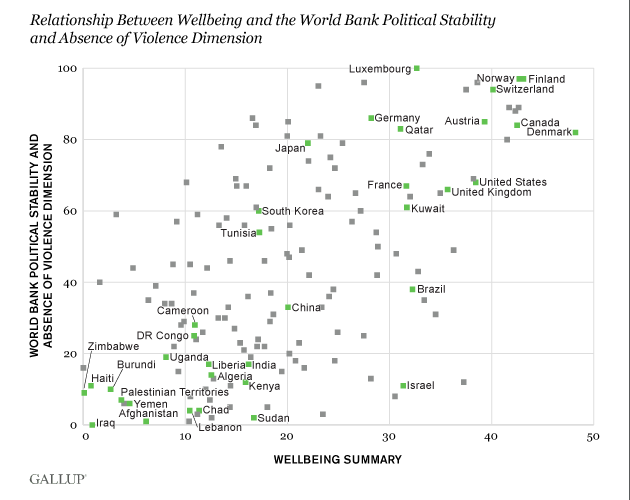
a new Gallup analysis finds countries with the highest wellbeing tend to be the most peaceful countries in the world and those with the lowest wellbeing are the least likely to be peaceful. Gallup’s life evaluation measure, which gauges wellbeing, correlates strongly with the Failed States Index and the World Bank’s Political Stability and Absence of Violence dimension, suggesting a clear linear relationship between peace and high wellbeing.
Not coincidentally, these countries are also highly secular. And the link between secularism, peace and wellbeing is one that is found in social science. In fact, Pitzer College professor and founder of the new Secularism Studies major, Phil Zuckerman, did a video lecture on this for ISSSC a while ago.
While there are certainly other factors involve in wellbeing and peace, secularism (and secularity) should be atop of social science explanations.
I was in Buffalo over the weekend. Not really in Buffalo exactly but in Amherst, NY at the Center for Inquiry’s global domination headquarters. I was a featured speaker at CFI’s annual leadership conference. This year’s theme “Moving Freethought Forward” clearly aligned with my current research interests in race and politics among secular Americans.
I arrived in Buffalo on Friday morning after being stranded for a while on Thursday night (airport celebrity sightings: Curt Schilling and Sen. Elizabeth Warren). After a brief check-in at the hotel and working a little on the first of my two presentations, I went to the CFI headquarters and was able to catch some of the morning sessions. The speakers in those sessions were some of the student participants discussing how their own college (or high school groups) organize and conduct events. The CFI staff also presented about some of their projects.
Watching those presentations gave me an idea of who most of my audience was (the other audience members were leaders of CFI branches, who at the time attended a different event). My first presentation was on the increasing diversity of secular Americans. While initially I focused on race, building on my presentation at the American Humanist Association conference in May, I shifted gears a bit and also discussed sex and gender identity. The movement, or at least the greater secular community, is not just a collection of old white males. Using data from my previous employers, the Institute for the Study of Secularism in Society and Culture (ISSSC) and Public Religion Research Institute (PRRI), I showed that the percentage of people of color and women have increased over time among the “nones.” I also included data on LGBT Americans that shows high levels of secularism among this population.
Sharing the stage with James Baldwin and Nemesio Canales
After the statistical part of the presentation I discussed why these groups are increasingly secular. While education is part of the explanation, I moved away from the usual STEM explanation: that as people learn about science they become more secular. Instead I argued that questioning the power structures in society can be a path to secularism. The picture on the left shows the slide where I placed two secular thinkers of color: James Baldwin and Nemesio Canales. Their secularism wasn’t the kind that refutes religion with science but the one that questions divine authority in light of very inefficient results.
I finished the presentation with a segway to my next presentation. In a slide showing different political leaders of different religions I made the argument that the politics of religious groups in America vary by race: white and black Protestants vote differently, as do white and Latino Catholics. But this is not the case with the Nones.
Trying to explain how to make up for a 40-year organizational deficit.
My second presentation compared a bit the secular left and religious right. They are mirror images of each other, with the exception that the latter is a major force in American conservatism, and the former a bunch of people who tend to agree on political and social issues. My goal was to show that regardless of nomenclature (nones, atheists, agnostics), secular Americans largely agree on the issues that are important today. Moreover, they also have similar levels of political party affiliation, and have been abandoning the GOP in the last quarter-century.
I liked how my presentations were received. Several students and leaders talked to me about what they liked and to continue a bit the conversation. Overall, it was a great conference. The diverse faces in the crowd: young men and women reflective of America’s diverse population give me hope about the future of the movement. Of course, the conference was not possible without the hard work of the CFI crew. I was finally able to meet Debbie Goddard in person and chat again with Paul Fidalgo. I also met Sarah Kaiser, Stef McGraw, and Cody Hashman, who made my life easier handling logistics and tech. And I had the opportunity to meet some amazing fellow presenters: Columbia’s Melanie Brewster, a rising star in the secular scholarly community; Desiree Schell is the person who can put in practice whatever theory of politics I come up with; Keith Lowell Jensen made my face hurt with his jokes, especially those about Max, his 5-year old tweeting daughter; and is always good to see James Croft, one of the most engaging speakers around and whose presentation was, luckily, after mine. I also want to thank Matt Enloe for tweeting a storm, the pictures in this post come from his account.






 The LatiNone