Iowa and the Future of Secular Politics

Many Iowans (on the Democratic side) felt the Bern, leading the former Independent-turned-Democrat Senator from Vermont to virtually tie Hillary Clinton in the caucuses there on Monday.

While Sanders’s lefty populism has been the catalyst fueling his surprising rise, I think his support also tell us a lot about the future of secularism and its relationship to US politics. In my opinion, Sanders is also benefiting from a more secular Democratic electorate. His message, in other words, is resonating with the rising secular left that is mostly comprised of young people with no religious affiliation.

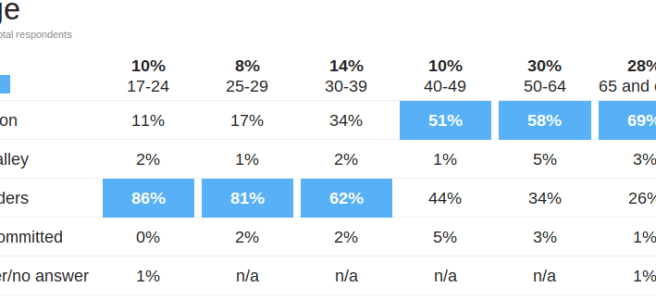
The entrance polls confirm that Sanders’s base is among young people. The CNN results show that Sanders’s support was concentrated among those under the age of 40. Indeed, more than 8-in-10 Democrats under 30 claimed to support Sanders.

The poll did not show results by religious affiliation. But as a proxy we can use the American Values Atlas, a project of the Public Religion Research Institute. PRRI’s analysis of Iowa religious demographics show that the fastest growth has been among young secular people. Moreover, secular people are largest religious cohort in the Democratic coalition in the state. Still, Iowa is not a very secular place. The size of its secular population is similar to the U.S. percentage, and the secular proportion of its Democratic coalition is similar to the proportion of the Democratic Party nationally.

The next stage is New Hampshire, which is terrain favorable to Sanders because is his turf (New England) and is above-average in its secular composition. The question is whether Sanders’s secular economic populist message can fare better once it moves away from New Hampshire and into more religious states. A friend once argued that candidates like Howard Dean (also from Vermont) had a problem reaching out to more traditional Democratic (religious) constituencies such as Catholics and African American Protestants. If Bernie, with a largely secular message can give Hillary a run for her money without major religious outreach, goes far in this race he will show that secular politics are possible the Democratic Party, even if he falls short in the end.


The Quest for Social Justice in Secular America is a Real Thing

That is a real thing. I just returned from an amazing meeting of the minds at the Secular Social Justice Conference at Rice University in Houston, TX. The event was organized by the Black Skeptics of Los Angeles, the Houston Black Non-Believers, and the Humanists of Houston. It was led by Dr. Sikivu Hutchinson, with the support of Dr. Anthony Pinn at Rice.

The conference was a great vehicle to connect secular people of color and allies who have been in the trenches of social change. The participant’s roll is a who’s who of secular leaders of color. In addition to Drs. Hutchinson and Pinn I was able to reconnect with the AHA’s Maggie Ardiente, CFI’s Debbie Goddard; finally met in person American Atheists’ Sincere Kirabo and Houston Black Non-Believers’ Ashton P. Woods, whom I knew from Facebook. In addition, I was able to meet in person two of my favorite bloggers: FreeThoughtBlogs’ Greta Christina and Stephanie Zvan.

I participated in the panel “What’s Race Got To Do With It? Racial Politics and Intersectionality In the Atheist Movement” with Frank Anderson, Georgina Capetillo, Alix Jules, Sincere Kirabo, Jimmie Luthuli, and Vic Wang. The panel was moderated by Daniel Myatt. We discussed many issues ranging from coalitions with religious people, our role as atheists of color in the secular movement, the state of intersectionality politics in the United States. Interestingly, the conversation ended with a discussion about the pros, cons, and possibilities (and a bit of definition) of revolution.

In addition to this panel, there were other 4 panels:

  • Feminism(s) of Color and the Secular Movement
  • Humanism and Hip-Hop
  • Finding Justice in an Economic System that Proclaims Financial Opportunity for All
  • LGBTQ Queer Atheists of Color and Social Justice

I attended the 1st and 3rd on the list since 1 &2 and 3 & 4 were held simultaneously. I ended in those panels after a coin toss, it was very hard to decide. Following the conversation in Twitter (#SSJCON) I realized that those panels I missed were as interesting as the ones I attended.

Over the next few days I will unpack a bit more of my experience in the conference and also try to flesh out what I said in the politics panel a bit more.


What I’ve been up to

I closed the old site in 2012 to adapt to a new full-time job that required moving from Connecticut to Washington, DC, and to work on my dissertation with the limited free time I was going to have. My level of activity in the secular world declined considerably, but I was still able to get in debates every once in a while. The pace picked up last year after completing my dissertation. Below is a list of my publications, media appearances, and speeches after shutting down the old blog.

Most of my writing was done for my employer’s (PRRI) blog. I used the platform to write about Latinos and politics. But I also did some writing on secularism. My writings on secularism from that period include an analysis of the secular vote between 1980 and 2008, the theological diversity of the secular population, a 2013 Darwin Day post on evolution and American public opinion, and a secular interpretation of New England’s embrace of same-sex marriage. My other blog-ish piece during that period was an article for Religion in the News in the Fall of 2013 titled “Congress gets a None.” The article chronicles the strange case of Arizona representative Kyrsten Synema’s decision to avoid the label “atheist” when discussing her religious beliefs.

Outside of the PRRI blog, I was able to publish 2 book chapters. “A World of Atheism: Global Demographics” was a collaboration with Dr. Ariela Keysar, my former colleague at the Institute for the Study of Secularism in Society and Culture, and published in the Oxford Handbook of Atheism. The chapter analyzes international survey research to come up with an estimate of the number of atheists around the world and came out in the fall of 2013.

The other book chapter was published in the summer of 2015 and also explores atheism using survey data. However, this time it is confined to the United States and touches the subject of (in)tolerance toward atheists. The chapter is titled “Nonreligious Tolerance: American Attitudes toward Atheists, America’s Most Unpopular Religious Group” coauthored with my former PRRI colleagues Dr. Robert P. Jones and Dr. Daniel Cox. It was included in Dr. Paul Djupe’s Religion and Political Tolerance in America. The other academic publication during this period is, of course, my dissertation The Diversity of Latino Ideology, which I defended in March 2015.

I discussed the world of religion surveys in two interviews. I appeared in Dr. John Shook’s show Humanist Matters on December 2013, and almost a year later (October 2014) I was interviewed by Hemant Mehta for the Friendly Atheist podcast. My other podcast appearance was discussing my talk about secular Latinos at the American Humanist Association conference in The Humanist Hour.

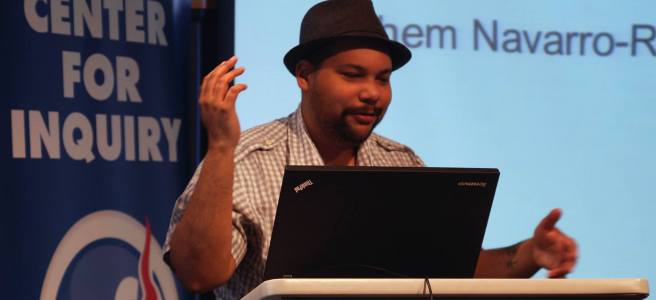
Finally, the completion of my dissertation allowed me to travel more than I had been able to in previous years. I took the chance to speak at three different conferences (an additional appearance had to be cancelled because it coincided with the birth of my child). In May I spoke at the 74th AHA conference in Denver. The title of my talk was “The Rise of the Latino Nones: How Secular Latinos will Shape the Future of American Secularism”. The next stop was Buffalo, where in late July and early August I addressed the student and community leaders in the Center for Inquiry’s Moving Freethought Forward Conference. I presented twice in the conference. A talk about racial diversity among the growing secular community titled “The Many Faces of American Secularism” and another on politics in the secular movement titled “Balancing The Force: The Secular Left as an Antidote to the Religious Right.”  I closed the year with a presentation in October as part of Humanist Haven, a series of talks sponsored by the Yale Humanist Community. The title was “The Nonreligious in American Politics: Challenges and Promises” and gave me the opportunity to return to Connecticut for the first time since my dissertation defense.

This year I have more in store. Tomorrow I depart for Houston to take part in the Secular Social Justice Conference. I also have 2 book chapters on secularism and race, 1 book chapter on immigration, and an article on secularism and race that should finally see the day of light (and print) at some point this year.

My permanent secular writing home

Over the past few months I’ve been moving back and forth between my official homepage at http://www.juhemnavarro.net and this site when blogging. As a new year’s resolution I decided to permanently move here. After some url issues were solved earlier this year, I’m finally able to transfer some old writings and start my new writing here again.

It’s been almost 4 years since I shut down the old LatiNone website. Back then the pressures of starting a new job in a new city while trying to complete a dissertation meant that some of my online activities had to go. Hence, the blog was placed in a semi-permanent hiatus.

I’m looking forward to start writing again in this blog. Hopefully with the frequency I did back in the day. In 2011 and 2012 (before I shut down), I was writing a short piece a day. I’m not sure if I can match that feat, but I will certainly try. In the meantime, use this site as a way to keep up with my upcoming appearances, announcements of new publications, and my musings on the intersection of race and secularism.

This Weekend: Secular Social Justice Conference

If you’re in Houston this weekend, consider stopping by the Secular Social Justice Conference. A great group of secular activists and/or scholars of color will be discussing how to advance social justice in the growing secular community.

I look forward to reconnect with leaders like Sikivu Hutchinson, Anthony Pinn, the AHA’s Maggie Ardiente, and CFI’s Debbie Goddard. I also hope to meet others whom I’ve followed for a while like Sincere Kirabo and Alix Jules. Hopefully, Greta Christina also makes good on her promise and attends!


Twenty Percent (or 7.5 Million!)

Today is December 12, the day of the Virgin of Guadalupe in Mexico. Which is a good day to remind people how Latinos’ religious composition has changed in recent years, and how large the secular cohort has become. We are now 20 percent of the Latino adult population, or 7.5 million. So, my secular Latino friends, look at this quick infographic and remember: you’re not alone.

La Guadalupana

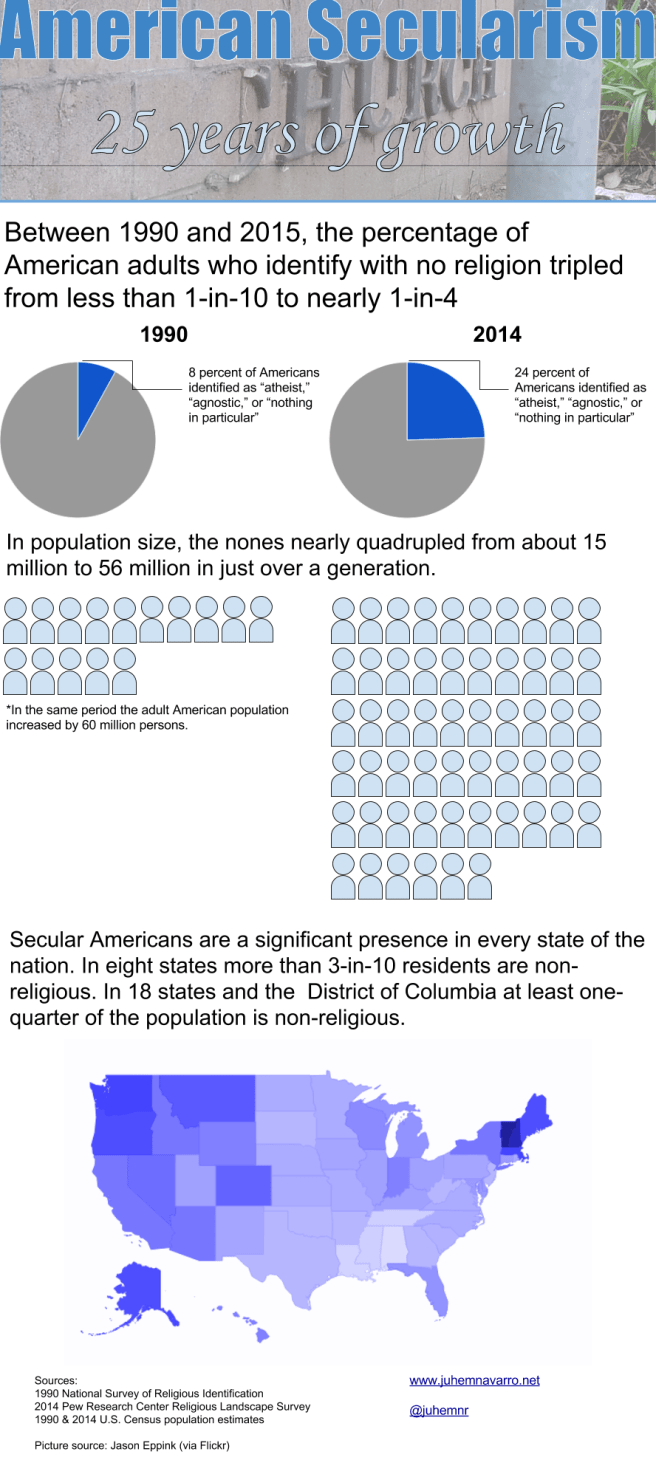
Secular Americans: 25 Years of Growth

This year is the 25th anniversary of the 1990 National Survey of Religious Identification. With a sample of over 100,000 interviews, it is the largest study of religious affiliation in the United States. Back then only 8 percent of Americans identified as “nones” or non-religious. Yet, when the successors of the NSRI, especially the 2008 American Religious Identification Survey, found that 1-in-6 Americans (15 percent) were non-religious, the press started noticing.

Today, the Pew Research Center and Public Religion Research Institute find that nearly one-quarter of the population is secular. The infographic below shows how this growth has happened percentage-wise and in terms of real population numbers.

25 Years of American Secularism (1)

Becoming secular…without science

The New Yorker recently published a piece profiling the deconversion of Megan Phelps-Roper. If the name rings a bell, it’s because she’s the grand-daughter of Fred Phelps, the late leader (and founder) of the infamous Westboro Baptist Church (WBC).

Phelps-Roper deconversion followed an interesting path. With access to the web, she joined Twitter and became the digital voice of the WBC. One of the features of Twitter is its ability of not only broadcasting a message, but also getting instant feedback. The WBC loves spreading their message, and this platform was well-suited for their usual trolling.

However, in Twitter Ms. Phelps-Roper also found a legion of detractors. Some of them later became friendly foes who engaged her as she spread the WBC’s message and planted the seeds of suspicion in her regarding the “truth” she had been taught. Ms. Phelps-Roper didn’t get interested in the theory of evolution, the Big Bang, or any other major scientific breakthrough that clashes with religious teachings. Her deconversion was a slow process emerging from a distrust of authority, a subject I recently-ish spoke about.

During one of my talks at the 2015 Center for Inquiry’s Leadership Conference I discussed the importance of non-scientific secularism. What I mean by this is that many people are becoming secular/non-religious not because they just got interested in biology or physics. Instead, people leave religion because they begin question its authority, and the authority of its leaders.

This is the case with Ms. Phelps-Roper. Her Twitter followers plated the seeds of distrust, but it was her analysis of how inconsistent and random the people in power at the WBC were with their new prophecies what led her to disbelieve what she had been taught.

It is also worth noting that one of the events that led to her leaving the WBC was the demotion of her mother as a major leader in the Church. Gender dynamics, where males took over absolute control of Church affairs, further fueled her questioning.

You should read the whole piece in the New Yorker. It gives great insights into the minds of young people leaving religion today. While Ms. Phelps-Roper case is an extreme one (in terms of the religious congregation she left), it is also an excellent example of how you don’t need science to distrust religion: its authority is dubious enough that people with critical thinking skills can see through the facade.

The Nones are Becoming More Honest

The most recent Pew poll released last week shows that the nones (secular Americans, aka: the “unaffiliated”) are becoming more secular, at least according to their own headline. In my humble opinion, the nones have just become more honest in their answers about their religious practices.

The recent report based on the belief and behavior questions in Religious Landscape Survey highlights two main findings. The first, that the nones are increasingly secular, the second that American soceity as a whole is also becoming more secular. As the figure below shows, the nones have become more likely to say religion is not important, more likely to admit they rarely pray or go to church. But the most amazing finding is that the percent who say they don’t believe in God increased by 50 percent, from 22 percent in 2007 to one-third (33 percent) in 2014.

Source: Pew Research Center

These numbers are the best evidence that being nonreligious is normalizing in American society. The trend is stronger among young people, who are more likely to know other nonreligious people. This may be because their friends in school or the neighborhood are not religious or because they are more technologically-minded and know other nonreligious thanks to the internet.

The other major finding of the report is that these measures of religious belief and behavior are declining among the population at large. However, the report is clear that there has been no major changes among religious Americans. This means that all of the change comes from the nones. This is very important because it means the nones are a group so large that they can now affect national trends by themselves. Hopefully we have not reached “peak secular” yet and more good news like these will continue to appear in future studies.

Puerto Rican Secularism: The Good, the Bad, and the Ugly

After digging the data from Pew for my previous post on atheism and non-religion in Puerto Rico, I decided to dig a bit deeper. I found more interesting pieces of information about the state of secularism in Puerto Rico. By secularism I mean not just the religious identification of people, but also their attitudes about religion and politics, as well as morality and public policy. The information can be divided in 3 types: good, bad, and ugly.

The Good

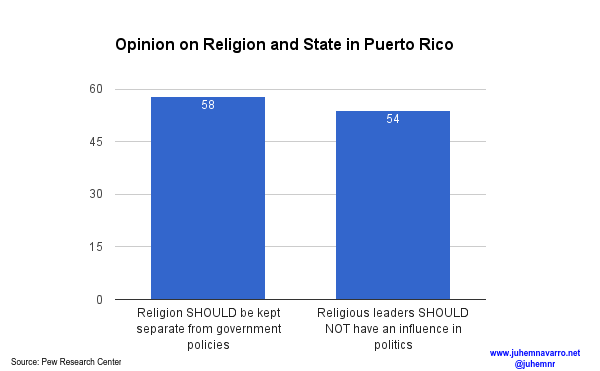
A majority of Puerto Ricans think the government should stay out of religion and that religious leaders should stay away from politics. Nearly 6-in-10 (58 percent) think that “religion should be kept separate from government policies.” Of course, this is something that elected officials have not been very good at, with the main example being the issue of susbtance abuse treatment I alluded to in my previous post.
rel_govt

Another hopeful sign is that a majority think that “religious leaders should not have an influence in politics.” This means that most people probably don’t like the many religious ceremonies often endorse or attended by elected officials.

In an unrelated note, though important for education policy. Nearly two-thirds (65 percent) of Puerto Ricans believe humans and other animals have evolved over time. This is encouraging, given the prevalence of religious schools, especially those run by Pentecostal ministries.

The Bad

Those are the good news, now the bad. In terms of views on social policy, even if most Puerto Ricans are religion/government separationists, their views on morality are very conservative. Take the example of same-sex marriage. While it is now legal, thanks to the Supreme Court recent decision, at the time of polling last year only one-third (33 percent) favored allowing people of the same sex to marry legally.

ssm_rel

The patterns of support among religious groups are predictable. Similar to what scholars find among religious groups in the United States, as this post by Public Religion Research Institute shows, Puerto Rican Protestants are the least supportive. Only 1-in-5 (20 percent) Protestants favor same-sex marriage. The percentage of Catholics in favor of same-sex marriage is nearly twice that of Protestants (39 percent) but still low. Even the religious nones in Puerto Rico are not fully in favor of same-sex marriage. Just under half (49 percent) of Puerto Rican nones favor same-sex marriage, a percentage much lower than the more than three-quarters of nones favoring same-sex marriage in the United States.

The Ugly

Support for same-sex marriage is low and so are the views on the morality of same-sex relationships. More than 6-in-10 (62 percent) say that same-sex relationships are immoral. Still opposition to same-sex marriage not as high as opposition to abortion. About three-quarters (77 percent) of Puerto Ricans consider abortion should be illegal and that abortion is immoral (74 percent).

Puerto Rican secularism needs to evolve. There are some positive signs regarding attitudes toward religion and government. However, religious belief is likely behind attitudes on social issues such as same-sex marriage and abortion. Fortunately, religion is not a large factor affecting belief in evolution. Another silver lining on social attitudes is that the vast majority do not think contraception use is immoral. The nones should take the positive signs and use them to change Puerto Rican politics and society harnessing those positive attitudes on religion/government separation.