
Check out this interview with Justin Scott in this week’s Humanist Hour. Scott is an Iowan and atheist who has been taking advantage of his home state’s spotlight as an opportunity for asking candidates about secular issues.
Political Secularism Moves Forward (Slowly)

Secular Americans want to be taken seriously in the political arena. And for good reason, the nones now rival Catholics as the single largest “religious” group in the country. Our numbers keep growing and we have little to show for it.
Two online pieces last week may me think that the tide may be finally turning. First, a press release by the Wisconsin-based Freedom from Religion Foundation announces the (re)launch of their “I’m secular and I Vote” campaign. From the release:
This sounds like a beginning of an organizing strategy. However, the final quote by Annie Laurie Gaylor “[m]any [secular voters] appear to be waiting for a candidate who acknowledges them as a group and speaks forcefully about keeping religion out of government,” makes me think that FFRF may be free from religious affiliation but not free from religious thinking. The quote indicates that secular Americans are waiting for a messiah, a “chosen one” politician who will finally pay attention to us.
Luckily, better news come from the American Humanist Association. An article in the Houston Chronicle there’s a brief description of the work done by the Center for Freethought Equality.
We need to do more of this elite-level type of politics. And our organizations need to take steps like endorsing candidates and contributing to campaigns. But if we want politicians to listen to us we need to produce our own political class. The secular leadership needs to come up with a game plan to develop candidates. Not just for Congress, but for lower local and state offices, places where future secular members of the national government can be trained in the art of governing. We cannot keep just relying on individual candidates outing themselves as secular and running fringe campaigns (as Libertarians or Greens), then complaining that “we are the most hated group” and that is why we cannot get elected.
Photo credits: “Reason Rally – Science, Reason & Secular Values” by Marty Stone (Flickr)
A Latino Deconversion Story
Diego Kal-El Martinez at Medium writes the story of leaving Catholicism and becoming an atheist. My favorite quote may be this one, that encapsulates what I think is a very common experience of people who were raised religious and are now nones.
I loved how he phrased that progression from religious to none. Moreover, I think it is a very common experience, especially among Latinos. Most people probably start doubting a tenet of the religion, a teaching, or just the authority of the religious leaders. Which is why I think a focus on science education as the sole route to atheism is misguided because it scares people into thinking that a particular knowledge set is a litmus test to become an atheist. Go and read the whole thing.
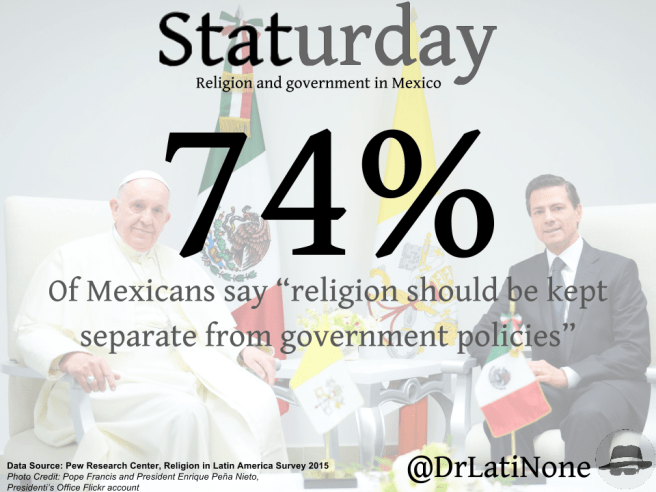
Staturday: Religion and Government in Mexico
Feature Friday: The Secular Latino Alliance
The internet has allowed people to create their own communities and the secular boom is probably related to people being able to find that they are not alone in their doubts about religious authorities, the existence of god, or their disdain for dogma. Latinos are not an exception to this and the internet has allowed us to find each other in different parts of the country and the world.
This is the case of the Secular Latino Alliance started by Sal Villareal. It is a website and Facebook group that allows Latinos who have left religion (or were never religious) to find each other, share experiences, and realize we are not alone.
If you know any atheist or otherwise nonreligious Latinos, or if you are one and you’re looking for a friendly place to chat exchange ideas, head over there.
Edit: Here’s a video of the group’s founders/admins in Aron Ra’s show the Ra-Men.
A suitable compromise #SCOTUS nominee
These are the characteristics that a President Obama-nominated candidate to fill the late Associate Justice Antonin Scalia’s seat that the Republican Senate will find inspiring and hard-to-pass on:
- White
- Male
- Ivy League-educated (preferably if he overcame the barriers of potentially losing his space to an affirmative action candidate because he was a legacy admission)
- A long legal career in the law firm of his CEO father’s best buddy from the country club
- During that legal career, standing up against tyranny such as the estate tax, environmental regulations, or any program that improves the lives of poor people.
Our “Cross” to bear

Some years ago my wife and I were on our way to pick up our car in the parking lot of the hotel we were staying to have dinner. As we hop in the elevator a white man who looked like he had just ran a marathon approaches us after listening us speaking in Spanish and asks us (in Spanish) to take a look at his sneakers. He wanted to show us that his sneakers were autographed by George Lopez, whom he had seen in the street after the marathon, and wanted to share his excitement with this Latino couple who surely were also fans of his. My “meh” reaction along with my wife’s “George who?” quickly made him realize that not all Latinos are fans of or know who is George Lopez.
I thought of that story while I was reading the reactions of a potential Ted Cruz (and to a lesser extent, Marco Rubio) run as the Republican candidate for President of the United States. With no Latinos in the race for the Democratic nomination, the possibility that the first Latino candidate for President (and potential first Latino U.S. President) will be a Republican has reignited the debate of who counts as a Latino. (For a good read of various arguments check this series of tweets from the National Institute for Latino Policy)
Technically, the fact that Senator Cruz does not hide his Cuba-born father away or changed his name to “Cruise” or “Cross” or started using his white, Delaware-born mother’s name to hide his Cuban roots should make him part of the Latino family. Rafael Cruz, Ted’s father is the equivalent of our crazy uncle and that makes Ted our crazy cousin.
It is true that Ted Cruz’s policy positions stand against what most Latinos stand for. But, whether politically or culturally, it is hard to find an “ideal” way of being a Latino. This is the case of those of us who are non-religious and who have to have to withstand the assumption that being a Christian, particularly a Catholic one, is the right way of being Latino. As an atheist Latino I reject the notion that one must possess a particular set of characteristics to be able to call oneself a Latino. (In fact, my dissertation is partially an effort to reconcile the cultural and social aspects of Latino identity into coherent political ideologies).
Sen. Cruz may not represent the interests or the preferences of most Latinos, but he represents a darker side of our collective DNA. He represents the nasty authoritarianism that has produced countless dictatorships in Latin America. He represents the Latin American elites who side with the powerful and colonial powers to exploit the poor and weak. He represents a dominionist brand of Christianity that has been exported from the U.S. around the world (including Latin America), spreading hatred and a jingoistic Americanism.
All these things have been in our midst for a long time: in every dictator and every colonial stooge that has placed the interests of multinational corporations and the war machine over those of their own. Ted Cruz is the culmination of that legacy, and if he becomes the biggest Latino “first” (as a Presidential candidate or as …shudder… President) this will be our “cross” to bear. Just like all Latinos are not George Lopez groupies, not all Latinos are working-class progressives. After all, homogeneity has never been our strongest suit.
Photo: Ted Cruz speaking at Values Voter Summit in Washington D.C. on October 7, 2011.(Source: Gage Skidmore [Wikimedia Commons])
Feature Friday: Darwin Day Flashback
American attitudes about evolution more than 200 years after Darwin’s birth and more than 150 years after the publication of On the Origin of Species remain complex. Nearly 4-in-10 Americans (38%) believe that humans have existed in present form since creation, while nearly 6-in-10 (57%) believe that humans have evolved. However, even those who believe in evolution are divided between those who think humans evolved through natural selection (30%) and those who think God guided evolution (22%).
Secularism elsewhere…Churches gotta pay; Police shouldn’t pray (on the job)
Churches in Mexico are under investigation for not paying taxes. Apparently, churches have to file tax forms and pay taxes for income “not related to religious activities.” While tithes and alms are exempted from taxes, this is not the case for other sources of income. Yet, even though the law requiring these taxes has been around for a couple of years, over 4,000 churches have not complied and may be audited. (Source: Sin Embargo [in Spanish])
Meanwhile, in my native land, the organization Humanistas Seculares de Puerto Rico is accusing the police department (PRPD) of proselytizing on the job. They have filed an official complaint with Puerto Rico’s civil rights commission. This particular claim is regarding the PRPD’s official proclamation of a “Lord’s favorable year” (whatever that means). This is not the first time the PRPD has been caught violating church-state separation. A couple of years ago they were caught organizing “faith blockages” where they stopped drivers in apparent routine traffic checks only to proselytize. (Source: Univision Puerto Rico [in Spanish]).
Why Candidates Ignore Secular Voters

Susan Jacoby published an op-ed in the New York Times on Sunday titled “Sick and Tired of ‘God Bless America’” where she bemoans the fact that despite being a fast-growing demographic, we the secular still get no respect from politicians. In the piece she asks a question that, well, she doesn’t answer:
The question is not why nonreligious Americans vote for these candidates [who pay lip service to religion] — there is no one on the ballot who full-throatedly endorses nonreligious humanism — but why candidates themselves ignore the growing group of secular voters.
I think I have three answers to the question why candidates ignore secular voters. The first one deals with the strength of secular identity, the second with the intersectional identities of many in the movement, the third is the lack of sophisticated political thinking in the secular community and its organizations.
Although the secular population keeps growing, as Jacoby rightly points out, it seems that most nonreligious Americans do not care much about religion. In other words, among those who identify as nonreligious, being secular is not a very important aspect of their lives. A bit of public opinion polling can help illustrate this point.
In 2012 Public Religion Research Institute, my former employer, released its annual American Values Survey. The 2012 AVS focused on religious change, with an emphasis on Catholics and the unaffiliated (or nones). One of the questions, which is more or less standard in religion studies, is asking the importance of one’s religious identity in our life. The AVS found three different types of religious nones: atheists/agnostics, secular, and a category called “unattached believers.” The latter tend to give more importance to being religious in their life, as 57 percent report that their religious identity is “the most” or “very” important. Among those who identified as secular only 12 percent said this identity is very important.
Self-identified atheists and agnostics are supposed to be the most active in terms of secular identity politics. These are the ones more likely to belong to secular organizations but only 13 percent say that this identity is very important. It is possible that many of these people are very active politically, but their secularism (as an identity) is not political. It is more of a personal choice, like being vegetarian.
It could also be the case, that many secular Americans have intersectional politics. This may be the case with younger cohorts, particularly women and people of color. I participated in the Secular Social Justice Conference earlier this month where I met many secular activists of color who are doing the tough balancing act of being openly secular and working for social justice on issues that are way beyond the sphere of church-state relations. These are people changing what we think of secularism and politics: moving beyond policing Ten Commandments monuments and opening prayers into making the world a better place. In other words, they are practicing their humanism.
But many secular people do not feel they have to bring their secular identity to the fore when doing social justice work. Many are working in political or social justice causes but their secular identity is superseded politically by other identity or identities. They are active politically, they have candidates listening to them, but they are focusing on other issues like when I was working on campaigns with Latino voters.
Finally, the secular movement is in its political infancy. The Religious Right has a 4-decade head start on us. They became a force in American politics not waiting for politicians to listen to them and whining when they don’t. They organized and used the power of their organizations to build an amazing infrastructure of think tanks, political training, and legal work.
They made politicians realize they matter. They didn’t sit around waiting for them to show up. If you do that, you will be irrelevant regardless of how large your presumed constituency is. Politicians don’t do outreach, they look for votes, sure-fire votes. The organizing is ours to do. So far our secular organizations have failed us in that regard. They have not shown the leadership required in the political arena.
There are some exceptions. Jacoby mentions the work of the Center for Inquiry’s Office of Public Policy, especially Michael De Dora. He is a great ambassador for politics, but the OPP’s work is primarily lobbying. Also, she calls CFI a think tank, and as much as I like the organization, I don’t think we have real think tanks in the secular world. I know think tanks, having worked for some or other sort for a decade and a half, the secular world is not even close to have the sort of think tank we need. Something like the Heritage Foundation…without the crazy stuff…is more akin to what we need.
There may be other reasons why we are not as strong politically as we should be. These are my three cents. But one thing is clear to me: it is ironic that a movement built on science and reason is waiting for miracles to happen.
 The LatiNone