Representation requires more than votes

The Pew Research Center released its now-traditional “Faith on the Hill” study of religion in Congress. Among the not-so surprising findings are that Christians are overrepresented compared to their share of the population. The most underrepresented group, once again: the nones (nonreligious/atheist/agnostic). Emma Green has a piece up at The Atlantic blaming nonreligious Americans for their lack of representation in Congress. In essence, she argues that secular Americans don’t vote in large numbers and for that reason they do not have enough members of Congress representing them. She also makes an argument that the movement is not coherent because many nonreligious people don’t really care about religion enough to organize about the issue.

Both arguments are wrong. Let’s take first the first argument that the nonreligious do not vote enough to get representation. Green shows a chart from PRRI (full disclosure: I was once an employee of PRRI) showing the percentage of people who identify as nonreligious in the general population and the percentage of nonreligious voters in exit polls. The latter number is always much smaller, but that does not mean that we are certain that the secular cohort is less likely to vote. Most general population polls are conducted over the phone (landline and cellphones) and/or (increasingly) online. Exit polls are mostly done face-to-face. Considering how disliked are nonreligious people, particularly atheists, in the United States, it is possible that many secular-minded people are not willing to tell a stranger their real religious beliefs.

Even if it were true that secular Americans are less likely to vote, they are still a significant part of the of the electorate and should have more than 1 openly nonreligious member. But in our political system numbers do not translate to equal representation. After all, women do not account for half of our representatives and people of color do not comprise a third of elected officials. Just because the number of secular Americans has jumped in the last decade, mostly thanks to young people, doesn’t mean that they have a pool of people ready to run for office and win offices that are not very often open for business when we consider the high reelection rates of incumbents.

There are some changes coming that way. In 2016, the Freethought Equality Fund, a secular PAC, endorsed several candidates, many of whom got elected and did not run away from identifying with a secular label or from the support of a secular group. These candidates ran mostly at the state and local levels and represent a growing bench of secular leaders.

On Green’s second point, that is hard to organize a group of people with little in common except for their lack of religion, truth is there is a lot in common. Secular Americans regardless of labels agree on many social and economic issues. As a Puerto Rican, I have experience with imagined identities among groups with a hint of history together. Latinos have become an important force by combining the forces of groups that share some traits, but also have some major differences (I know a bit about this, trust me).

There are important problems of collective action in the secular movement that hinder its ability to become a major political force in the short term. I’ve written about this before. But there are important structural and cultural problems in this country exacerbating the lapses in political organization in the secular movement. Those are to blame for the lack of representation during this decade. We need to work on reversing them in the future.


Colorblind Conservatism

At TheHumanist.com, Sincere Kirabo writes about black conservatives. In the piece he dismantles the arguments of African-American speakers at the Republican National Convention in Cleveland. A task simplified by the fact that there were so few, most fit in one magazine column. A sample quote below:

Black conservatives, along with their brethren, favor respectability politics and place faith in the idea of “pulling yourself up by your bootstraps”—both notions supported by a victim-blaming rationale that neglects the way some identities are privileged over others.

Sincere Kirabo, “The Black Conservative Anomaly

Though Kirabo’s focus is the current lineup of black conservatives in the GOP, black conservatism is an ideological current with a long history, something I learned during my years in graduate school. In fact, it was the scholarship on African-American ideologies, particularly the work by Michael Dawson and Melissa Harris-Lacewell (today Harris-Perry), what inspired me to write a dissertation on Latino ideology.

In this regard, Kirabo’s piece reminds me of Chapter 3 of W.E.B. DuBois’s The Souls of Black Folk. That chapter is a serious takedown of the respectability politics and black conservatism of Booker T. Washington.

There’s a big difference between Washington and today’s black conservatives in the GOP. Washington’s conservative rhetoric included actions, such as the founding of the Tuskegee Institute. He was part of a debate about how to improve the conditions of the African-American community after the collapse of Reconstruction. Today’s GOP black conservatives deny there’s a problem at all, or that the problem lies in individual responsibility.

Which leads me to the contradiction of today’s GOP. As the party has moved from “dog-whistle” statements about race to explicit racism, it has also seen a boom in elected officials of color. The Party of Trump has South Carolina’s Tim Scott, the only African-American U.S. Senator, two Latinos in the U.S. Senate (Marco Rubio and Ted Cruz), as well as governors Brian Sandoval (NV) and Susana Martínez (NM), Indian-American governors Nikki Haley (SC) and Bobby Jindal (LA). Let’s not forget Dr. Ben Carson’s and Alan Keyes’s presidential aspirations. This shows that the party’s base may be racist, but also colorblind. They will elect anyone who spews the hateful rhetoric and reality-denying views they like.

The other day I was watching cable news in room as I waited for a meeting. I don’t recall which network it was, but I recall hearing something like this: A commentator asked where are the reasonable black conservatives like Colin Powell, Condoleeza Rice, and Michael Steele. And I though to myself, if Michael Steele is now considered a reasonable black conservative, the Republican Party is beyond salvation.

When Religious Privilege Kills

One of the saddest articles I’ve read in a long time is this piece at Reveal News about the regulation exemptions for religious non-profits allowing them to run daycares with little to no supervision. This has led to maany horror stories of accidents and deaths of children that could have been prevented. This part of the article is quite revealing:

Religious advocates suggest parents need not worry about the lack of oversight because day cares are guided by a moral authority that eclipses any regulatory agency.

In other words, because they respond to a “higher authority” these institutions don’t need to be accountable to the state. We seriously need to end religious privilege in this country and treat religious institutions not as special snowflakes but as any other organization that is bounded by the earthly rules of government.

Bernie, the Donald, and the Nones

A couple of weeks ago Mark Silk wrote about a Pew poll that found that majorities of nones supported Sen. Bernie Sanders and Donald Trump in their respective party contests. According to the poll, 61 percent of Democratic or Democratic-leaning nones favor Sanders over former Secretary of State Hillary Clinton. Thirty-five percent prefer Clinton. On the Republican side, 57 percent of nones support Trump while Sen. Ted Cruz and Gov. John Kasich lag well behind with 17 percent each.

The survey confirms a hunch I’ve had for a while. In my social media feeds there are apparently more Sanders than Clinton supporters. Of course, my maybe 1,000 social media contacts (some of them repeated across platforms and not all of them secular) are not likely to be representative of the nones, but those suspicions now are confirmed.

Sen. Sanders’s support is strongest among young Americans of the Millennial generation. This happens to be the most secular generation as well. On paper, it is also a generation that is to the left of the general population on social/economic issues (in favor of more spending on government services and the social safety net). In this regard secular Millennials are the core of Sanders’s coalition.

Sen. Sanders’s support is strongest among young Americans of the Millennial generation. This happens to be the most secular generation as well

What I wasn’t sure, though I also had a hunch, was the preferred candidate among Republican nones. My social media contacts were no good for this since I barley have any Republicans, let alone any Republican nones (these are very rare). My hunch was that the GOP-leaning nones’ preferences were maybe leaning toward Trump, and that Kasich would be ahead of Cruz. And I was way off-target in that regard.

Two-thirds of Republican nones are men according to Pew’s Religion Landscape Survey.

My reading of the Republican nones assumes that this is a conservative group on economic matters but more liberal on cultural matters. That assumption is likely correct and will be the subject of a forthcoming post. Trump, depending on the day, is the least religious candidate in the Republican field, a positive for those who only care about Church-State issues. What I probably underestimated is the extent of the racism, sexism, and hatred to “pc dialogue” among many in the secular community.

 It’s fair to say that, for the first time in American history, the Nones making their influence felt on the presidential nominating process.

-Mark Silk, Spiritual Politics, “The Year of the Nones

I am aware that some communities such as men’s rights activists and even groups of white supremacists can be a draw for secular men. And  I think that is what drives Trump’s high numbers among the Republican nones, who are primarily young men. Two-thirds of Republican nones are men according to Pew’s Religion Landscape Survey.

Mark Silk interprets the Pew poll findings as part of a “year of the nones”making their influence felt on the presidential nominating process.” I partly agree with that interpretation. It is true that the nones are becoming larger portions of the parties’ coalitions. But the secular movement keeps waiting for the parties to knock on their doors instead of trying a hostile takeover of party structures. What I mean is that nones are not being organized as political blocs but rather as individual voters who happen to coincide in their preferences for particular candidates. That is no way to gain any sort of clout.

While I think the none vote will be decisive, it is less clear if politicians will care until there is a coordinated effort in the secular leadership to exploit their strength in numbers. In that sense I would modify Silk’s “year of the nones” to the “year of the none” because it is the coincidence of individual nones what may become decisive in this primary season, rather than the collective undertaking of the nones to affect the ouctome of the elections.

Image Source: ABC News


Secularism and the Vanishing Latino Republicans

Are Latino Republicans an “endangered species”? That’s the question Prof. Stephen Nuño tries to answer in NBC Latino. Personally, I think that is the case. And obviously, I think growing secularism is a major contributor.

Although Prof. Nuño points out the past admiration of many Latinos for Ronald Reagan and the growing community of Latino small business owners were once a booming Republican constituency. Those factors, coupled with a grwoing anti-Comunist Cuban-American voting contingent (I may add) made the GOP attractive to many Latinos.

[I]t may surprise people to know that the GOP was once a party of promise for aspiring Latino businesspersons, parents who sought choice in education for their children, and Latino churchgoers where Catholicism still has a strong influence on Hispanic culture.

Dr. Stephen Nuño

I may also add that later on the growth of Latino evangelicals who shared the social conservatism (and some even shared the economic conservatism) of white evangelical Protestants made some scholars, like my mentors Barry Kosmin and Ariela Keysar, to hypothesize that the GOP had a Latino future with this growing constituency.

This is no longer the case. Young Latinos, like other young Americans, are abandoning organized religion. Like other secular Americans, secular Latinos are more liberal in their issue preferences than the rest of the population. Thus, as more Latinos become secular, the proportion of Latinos who are liberal also increases.

The percent of Latinos voting for Republican candidates has declined since 2004. In 2012 Latinos registered a record support for Barack Obama’s reelection. Many factors have been cited as a source for this left turn such as the blatant racism of the GOP base on immigration and the GOP’s disdain of the working poor in the aftermath of the Great Recession, constituencies that many Latinos are part of. One that is seldom mentioned is the growing secularism of Latinos, particularly young ones. Increasing secularism adds an additional layer of complexity to Republican outreach efforts for two reasons: policy and outreach.In this post I am addressing the policy differences.

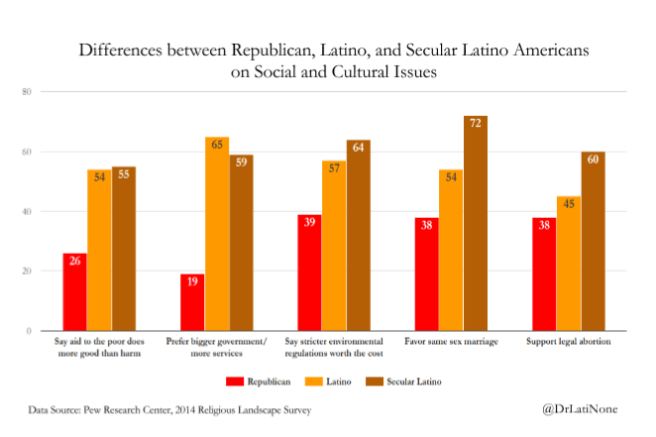
Secularism and the Vanishing Latino RepublicansIn terms of policy, secular Latinos don’t agree with Republicans on issues of social (economic) or cultural (culture war issues) policy. An analysis of the 2014 Pew Religious Landscape Survey shows that Latinos are well to the left of Republicans in most issues. Secular Latinos are even farther from Republicans on most issues, too.

Increasing secularism adds an additional layer of complexity to Republican outreach efforts for two reasons: policy and outreach.

In terms of social policy Latinos consider that government aid to the poor  does more good than harm and that environmental regulations are worth their economic cost. This is consistent with the view of nearly two-thirds of Latinos who say they prefer a larger government with fewer services. Secular Latinos are even more liberal on matters of environmental policy and similar to all Latinos regarding aid to the poor. They are slightly less liberal on the size of the government. In all three questions they are well to the left of Republicans.

Latinos are more conservative on cultural issues like same-sex marriage and abortion and religion is probably the culprit. Unsurprisingly, on these two issues is where secular Latinos distinguish themselves from the Latino population in their liberalism. Needless to say, they are well to the left of Republicans.

A party that shows no concern for the poor, the environment, women, or LGBT Americans will have a hard time attracting secular voters. The Latino secularization makes sure that whatever inroads the GOP made with Latinos will become undone with this growing constituency.

This Year Race Trumps Religion

My good friend and old colleague Dr. Mark Silk calls the end of religious identity politics a couple of weeks after declaring the Religious Right dead. Personally, I think race is trumping (no pun intended) religion this year, but as the natural progression (regression?) of an ideology rooted in white Christian supremacy. He writes:

In a crazy political year, perhaps we have one thing to applaud: the evident end of religious identity politics. Evangelicals have been decidedly lukewarm toward preacher’s kid Ted Cruz and fellow-traveler Rubio, and they showed no interest whatsoever in Mike Huckabee this time around. Jews, so far as we can tell, are not particularly feeling the Bern. And Catholics barely gave Jeb Bush and Rick Santorum the time of day.

I’m not so sure this end is a reason to applaud. The Republican Party is a Christian Party -or a party for certain types of Christians. All the candidates openly praised god, the Christian version of it. While it is true that some candidates were more a part of the Christian/Religious Right than others, at this point in history every potential GOP candidate knows what religious buttons to push.

Since all of them love Jesus, they have to differentiate each other by expressing who they hate the most. The foreign policy proposals of all the GOP candidates are about blowing up anything that is outside of our borders. Only Trump stands out by viciously (and explicitly) attacking and threatening violence against their domestic others: religious minorities, black, brown, red, and yellow, independent women. That’s why Trump is so appealing. And that’s no reason to applaud.

Photo credit: Donald Trump at 2015 CPAC. Source: Wikimedia Commons.

Replace Scalia with an Immigrant Child

I sometimes think that in the minds of conservatives, the best constitutional scholars in this country are not in the Supreme Court, in the halls of our top universities, or in the offices of major legal institutions. The rhetoric about people coming to the United States and immediately gaming the system suggests that in the minds of anti-immigrant conservatives (a Venn diagram that becomes smaller each passing day) our most brilliant legal minds are those who risk life and family to come to undocumented into this country.

Now, a judge thinks that the brilliant legal minds coming to the country includes the thousands of children detained trying to cross the border. According to Judge Jack Weil based in Virginia, children as young as age 3 can be explained our immigration laws and can forgo legal representation.

I’ve taught immigration law literally to 3-year-olds and 4-year-olds. It takes a lot of time. It takes a lot of patience … They get it. It’s not the most efficient, but it can be done.

Judge Jack Weil

I think that his logic opens wide open the pool of candidates to replace the late Justice Antonin Scalia. But in all seriousness, this is appalling. This is the same logic that condones charging children as adults. Children of color in this country are not allowed to be kids, they are dangerous minds from birth and not worthy of civil or human rights. And yet we ask why Donald Trump is so popular.

Representing Secular Family Values

It is a well-known fact that the United States is the only major industrialized country in the world without a decent mandatory paid parental leave. I was once again reminded of that sad fact of life in America after reading Jessica Shortall’s piece in The Atlantic and think that this should be a major part of the secular political agenda.

Parental leave is once another part of our health and welfare system left up to capitalism to figure out. As Shortall puts it ” the time for rest, bonding, and recovery often is determined not by tradition, or even by a doctor’s recommendations, but by the new mother’s employment situation.”

This happens in a political system where the national legislature and a majority of states are controlled by those who claim to be in favor of “family values.” Of course, we know that “family values” mostly means “opposing abortion.” It means caring about the binary life/death outcome of a fetus. But it does not mean caring about the fetus having decent prenatal care, or the opportunities to live a fulfilling life once out of the womb.

In the United States, however, the time for rest, bonding, and recovery often is determined not by tradition, or even by a doctor’s recommendations, but by the new mother’s employment situation.

Jessica Shortall

Those “family values” are promoted by elected officials who are mostly male, overwhelmingly white, economically well-off, and practitioners of a toxic brand of Christianity. These elected officials are not representative of the people, not only because they do not look like the American people, but because 82 percent of Americans are in favor of paid parental leave and 85 percent favor paid sick days.

Instead of those “family values,” I propose secular family values. Those are values that promote the equality of sexes, not the continual subjugation of women based on ancient scripture. Parents should have the right, not the privilege as it is today, to spend time with their children. This is why we need to do more than voting. We must promote our own candidates and become more involved in political activism. Until secular people become engaged in politics as a united front: running for office, contributing time and money, endorsing candidates, challenging candidates, hosting debates, our values will not be prominently featured. We can show the American people that we about things other than policing prayer and religious symbols in public. That we care about people. And that you do not need religion to do so.

3 Reasons a Majority of Latinos Support Reproductive Rights

A new survey finds, once again, that a majority of Latinos favor abortion rights for women. Unfortunately, the images the media have on Latinos mostly fall into two camps. There are those who think we are all Catholic and who pray for the intercession of the Virgin of Guadalupe in an hourly basis. Or, thinking that the fastest-growing religion among Latinos is Pentecostalism. Most people are wrong on both assumptions and it matters when it comes to understanding Latinos and abortion rights. A majority of Latinos are in favor of legalized abortion, access to healthcare for women, and other reproductive rights for three reasons: partisanship, religious practice, and growing secularism.

Legal access to abortion is a mainstream position in the Democratic Party and a majority of Latinos identity as Democrats. While there may be pockets of socially conservative Latinos who identify as Democrats, most Latinos agree with their co-partisans as I pointed out a few years ago. Thus, it should be not surprising that a group in which a majority identify with a party where most members approve of legal access to abortion are in favor of a woman’s right to choose.

Of course, abortion and contraception are still banned by the Catholic Church. But PRRI’s Hispanic Values Survey found that Latino Catholics are split on the matter of abortion. It is fair to assume that a majority of Latino Catholics who identify as Democrats are in favor of legal abortion. The same survey find that many Catholics disagree with the Church’s teachings on many issues. This makes sense because, as I pointed out in my interview in The Ra-Men Podcast earlier this week, there are variations of belief and practice among Latinos, especially Catholics. Many Latinos are Catholic due to tradition or cultural inertia and do not think much of it. They may celebrate Catholic holidays and practice sacraments once in a while, particularly those that are part of life-cycle events such as baptisms and marriages, but not think about the religion and its rules as a matter of everyday decision making. In other words, many Catholic Latinos live very secular lives.

Although Pentecostalism among Latinos makes headlines, the truth is that the fastest-growing “religious” group among Latinos is the nones. Most of the nones are former Catholics who are admitting what has been obvious for a long time. Many Catholics are so by tradition and now feel free to admit what they have felt for a long time. The Latino nones are more liberal on social issues, as nones in general tend to be in American politics. This is confirmed by many polls, including the PRRI and Pew polls linked here.

We try to rationalize why Latinos’ historically conservative attitudes on social issues keep shifting to the left as if the population is predominantly Christian. It is still is, but not to the extent it was a generation ago. The growth of Latino secularism has implications for American politics as candidates and strategists, and the community’s leaders attempt to understand how to harness the power of Latinos’ numbers. As progressives we need to realize that a secular left is slowly forming, that it has the potential of being a multi-racial and multicultural coalition. Most importantly, progressives need to stop pandering with token religious language to a constituency that with each passing day becomes more secular. It is shortsighted, shows a disregard for facts and trends in favor of stereotypes, and it is insulting to those that are a key player in the future of the movement.

Photo Credit: USC University Church Sign by Jason Eppink (Flickr)


Signs of the Apocalypse: (Almost) Agreeing with David Brooks

Yes, you read that correctly. Last week David Brooks, conservative New York Times columnist, penned a column that I mostly agree with.

He writes about the rise of antipolitics, or a method of wanting and attempting to impose your views about society and policy as if other groups or interests different from your own are not just matters of disagreement, but illegitimate. This antipolitics stands in contrast with politics, or the process of making decisions through public debate and compromise because people acknowledge the existence of varying and often contradictory interests. Eventually, the antipolitics people participate in elections, often with the following consequences, which is my favorite quote of the piece:

“The antipolitics people elect legislators who have no political skills or experience. That incompetence leads to dysfunctional government, which leads to more disgust with government, which leads to a demand for even more outsiders.

The antipolitics people don’t accept that politics is a limited activity. They make soaring promises and raise ridiculous expectations. When those expectations are not met, voters grow cynical and, disgusted, turn even further in the direction of antipolitics.”

This is why messianic movements are dangerous. A democratic process is imperfect. While victories by the antipolitics fans will not yield the desire results, even if they did it does not mean the culmination of a process or the pinnacle of politics. New problems will arise from the proposed solutions. That is the problem with and the beauty of politics: decisions always have to be made because the conversation never ends.

Even when I agree on these general points about the danger of antipolitics, Brooks still thinks there’s blame to throw around for the left and the right. He’s quite wrong about this. Crazy conspiracy-driven authoritarian lefties are not part of the Democratic Party elite. By contrast, we can find many examples in the right because the Religious Right is the mainstream of the GOP. The day when Lyndon LaRouche and his followers get enough clout in the Democratic Party to influence patform and strategies will be the day when the false equivalency between the crazies in the right and the crazies in the left will stop being false. In the meantime, Mr. Brooks, it is your people who have driven our political process to a standstill.

Photo credits: “Obama’s Plan White Slavery” by Flickr user cometstarmoon