
Author: Dr. Juhem Navarro-Rivera
3 Reasons a Majority of Latinos Support Reproductive Rights

A new survey finds, once again, that a majority of Latinos favor abortion rights for women. Unfortunately, the images the media have on Latinos mostly fall into two camps. There are those who think we are all Catholic and who pray for the intercession of the Virgin of Guadalupe in an hourly basis. Or, thinking that the fastest-growing religion among Latinos is Pentecostalism. Most people are wrong on both assumptions and it matters when it comes to understanding Latinos and abortion rights. A majority of Latinos are in favor of legalized abortion, access to healthcare for women, and other reproductive rights for three reasons: partisanship, religious practice, and growing secularism.
Legal access to abortion is a mainstream position in the Democratic Party and a majority of Latinos identity as Democrats. While there may be pockets of socially conservative Latinos who identify as Democrats, most Latinos agree with their co-partisans as I pointed out a few years ago. Thus, it should be not surprising that a group in which a majority identify with a party where most members approve of legal access to abortion are in favor of a woman’s right to choose.
Of course, abortion and contraception are still banned by the Catholic Church. But PRRI’s Hispanic Values Survey found that Latino Catholics are split on the matter of abortion. It is fair to assume that a majority of Latino Catholics who identify as Democrats are in favor of legal abortion. The same survey find that many Catholics disagree with the Church’s teachings on many issues. This makes sense because, as I pointed out in my interview in The Ra-Men Podcast earlier this week, there are variations of belief and practice among Latinos, especially Catholics. Many Latinos are Catholic due to tradition or cultural inertia and do not think much of it. They may celebrate Catholic holidays and practice sacraments once in a while, particularly those that are part of life-cycle events such as baptisms and marriages, but not think about the religion and its rules as a matter of everyday decision making. In other words, many Catholic Latinos live very secular lives.
Although Pentecostalism among Latinos makes headlines, the truth is that the fastest-growing “religious” group among Latinos is the nones. Most of the nones are former Catholics who are admitting what has been obvious for a long time. Many Catholics are so by tradition and now feel free to admit what they have felt for a long time. The Latino nones are more liberal on social issues, as nones in general tend to be in American politics. This is confirmed by many polls, including the PRRI and Pew polls linked here.
We try to rationalize why Latinos’ historically conservative attitudes on social issues keep shifting to the left as if the population is predominantly Christian. It is still is, but not to the extent it was a generation ago. The growth of Latino secularism has implications for American politics as candidates and strategists, and the community’s leaders attempt to understand how to harness the power of Latinos’ numbers. As progressives we need to realize that a secular left is slowly forming, that it has the potential of being a multi-racial and multicultural coalition. Most importantly, progressives need to stop pandering with token religious language to a constituency that with each passing day becomes more secular. It is shortsighted, shows a disregard for facts and trends in favor of stereotypes, and it is insulting to those that are a key player in the future of the movement.
Photo Credit: USC University Church Sign by Jason Eppink (Flickr)
My Appearance in The Ra-Men Podcast is now Online
I discuss the rise of secular Latinos, the presidential race, and politics in the secular movement with Aron Ra and Lilandra Ra.
Signs of the Apocalypse: (Almost) Agreeing with David Brooks

Yes, you read that correctly. Last week David Brooks, conservative New York Times columnist, penned a column that I mostly agree with.
He writes about the rise of antipolitics, or a method of wanting and attempting to impose your views about society and policy as if other groups or interests different from your own are not just matters of disagreement, but illegitimate. This antipolitics stands in contrast with politics, or the process of making decisions through public debate and compromise because people acknowledge the existence of varying and often contradictory interests. Eventually, the antipolitics people participate in elections, often with the following consequences, which is my favorite quote of the piece:
This is why messianic movements are dangerous. A democratic process is imperfect. While victories by the antipolitics fans will not yield the desire results, even if they did it does not mean the culmination of a process or the pinnacle of politics. New problems will arise from the proposed solutions. That is the problem with and the beauty of politics: decisions always have to be made because the conversation never ends.
Even when I agree on these general points about the danger of antipolitics, Brooks still thinks there’s blame to throw around for the left and the right. He’s quite wrong about this. Crazy conspiracy-driven authoritarian lefties are not part of the Democratic Party elite. By contrast, we can find many examples in the right because the Religious Right is the mainstream of the GOP. The day when Lyndon LaRouche and his followers get enough clout in the Democratic Party to influence patform and strategies will be the day when the false equivalency between the crazies in the right and the crazies in the left will stop being false. In the meantime, Mr. Brooks, it is your people who have driven our political process to a standstill.
Photo credits: “Obama’s Plan White Slavery” by Flickr user cometstarmoon
Evangelicals supported Reagan. Why not Trump? – Spiritual Politics
In 1980, white evangelicals switched their allegiance from Jimmy Carter, a Southern Baptist who taught Sunday school, to Ronald Reagan, a divorced, non-churchgoing media celebrity who had opposed restrictions on gay rights and signed one of the nation’s most liberal abortion laws. So why should anyone be surprised that many evangelicals are now supporting a divorced, non-churchgoing media celebrity whose record on the social issues is well to the left of his Republican rivals? –
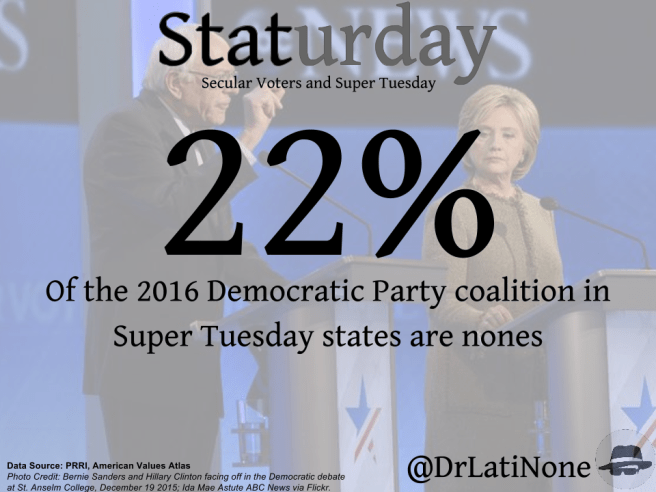
The Nones are an Important Super Tuesday Bloc

Last week Public Religion Research Institute published a short report on the religious affiliation of self-identified Democrats and Republicans in states with contests on Super Tuesday (tomorrow).
It is not surprising that the nonreligious comprise a larger portion of the Democratic Party coalition than the Republican’s. According to the data collected for the American Values Atlas, more than 1-in-5 (22 percent) Democrats are nones, but only 1-in-10 Republicans are.
In three states the nones comprise at least 3-in-10 Democrats: Colorado (34 percent), Massachusetts (31 percent), and Minnesota (30 percent). Among Republicans, Alaska has the highest rate of nones in their coalition. One-in-five (20 percent) of Alaska Republicans are nonreligious.
Considering that the PRRI analysis divides the party coalitions in large racial and religious groupings, it is fair to assume that in most of these states the nones represent the largest segment of the Democratic Party.
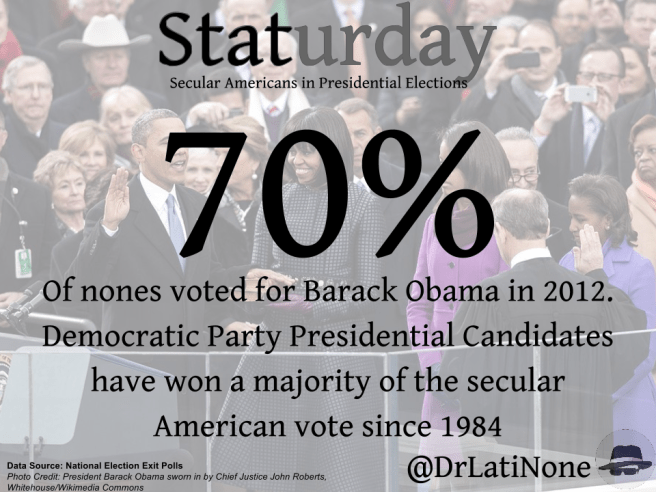
Unfortunately, contrary to most of those racial/ethnic/religious groups, the nones are not as well organized politically. We do not have a well-organized secular left even though the nones have been consistent supporters of Democratic candidates for nearly 4 decades and were an important part of Barack Obama’s coalition. But until we take party politics seriously, we will not be more than a vote taken for granted but not actively mobilized. The time is due for a powerful and strong Secular Left to serve as an antidote to the damage the Religious Right has done to this country.
Photo Credit: Bernie Sanders and Hillary Clinton facing off in the Democratic debate at St. Anselm College, December 19 2015; Ida Mae Astute ABC News via Flickr.
Weekly Summary
I started the week commenting on the story of Diego Kal-El Martinez, whose post at Medium narrated his journey away from Catholicism to atheism. On Tuesday I tackled secular politics again by comparing two organizational perspectives: the Freedom from Religion Foundation and the American Humanist Association. While the AHA is placing some capital in activities aimed at getting the attention of political elites, the FFRF keeps hoping that the secular messiah will show up and finally represent the interests of secular voters.
For Feature Friday, I linked to Justin Scott’s interview in The Humanist Hour. The Staturday number of the week was the percentage of nones who voted for Barack Obama in 2012. Finally, I quote and link to a post by Latino Decisions’s David Damore explaining why Donald Trump did not win the Latino vote in the Nevada caucuses.
Latino Decisions’s Take on the Latino Vote in Nevada
The entrance poll has a very, very small sample size of Latino Republicans, perhaps only 130, which means that even if everything else is perfect in its methodology, it carries a +/- 8.5% points on the Latino sample. Further, the Nevada entrance polls are not designed to get accurate subgroup vote share estimates, but rather report on statewide numbers, so their design is not trying to capture a representative sample of Latino Republicans, which adds some amount of unknown bias, beyond the +/- 8.5%
Staturday: Secular Americans in Presidential Elections
Feature Friday: Atheists and Presidential Candidates
Check out this interview with Justin Scott in this week’s Humanist Hour. Scott is an Iowan and atheist who has been taking advantage of his home state’s spotlight as an opportunity for asking candidates about secular issues.
 The LatiNone